

FOUR LOCATIONS ONE EXPERIENCED TEAM
If you’re researching hair transplant options, you’ve probably come across three commonly discussed approaches: ARTAS iX, Manual FUE, and DHI. Each technique can be effective when used appropriately, but none is automatically the “best” option for every patient.
The right choice depends on factors such as your pattern of hair loss, donor density, hair characteristics, treatment goals, and the clinical judgement of your surgeon. While marketing materials often promote one technique over another, the reality is that each approach has strengths, limitations and situations where it may be more suitable.
This guide explains how ARTAS iX, Manual FUE and DHI differ, where each technique may offer advantages, and why a comprehensive consultation is more important than the technology itself.
Importantly, ARTAS and DHI are not direct equivalents.
ARTAS mostly relates to how grafts are harvested, while DHI mostly relates to how grafts are implanted. Manual FUE may be used alongside either conventional implantation techniques or DHI-style implantation.
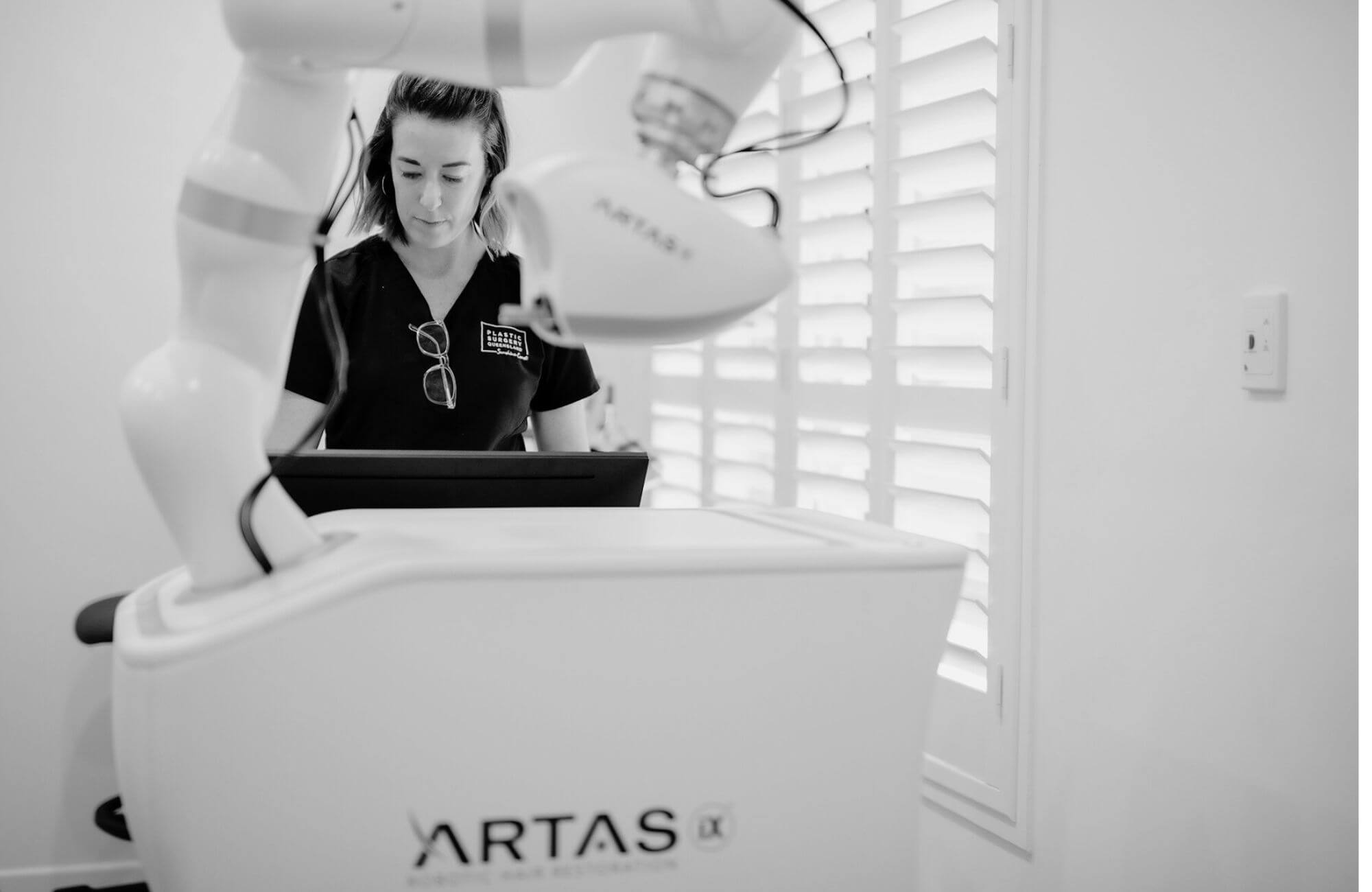
ARTAS iX is a robotic-assisted hair restoration system that uses digital imaging, artificial intelligence and robotic technology to assist with follicular unit extraction.
The system identifies and selects suitable follicular units within the donor area and assists with creating consistent extraction sites. The harvested grafts are then prepared and implanted according to the surgeon’s treatment plan.
At Plastic Surgery Queensland, ARTAS iX is used as part of the overall surgical process rather than operating independently. Surgical planning, hairline design, patient selection and implantation decisions remain under surgeon supervision.
Follicular Unit Extraction (FUE) is a technique where individual follicular units are extracted directly from the donor area using handheld instruments.
Unlike the robotic approach, extraction is performed manually by an experienced practitioner.
Manual FUE remains one of the most widely used hair transplant methods globally because it can accommodate a broad range of hair types, curl patterns and clinical situations.
The quality of Manual FUE depends heavily on experience, planning and execution throughout the procedure.
DHI stands for Direct Hair Implantation.
Rather than describing a harvesting method, DHI refers primarily to how grafts are implanted into the recipient area.
After grafts are harvested, specialised implantation pens are used to place follicles directly into the scalp.
Proponents of DHI suggest that the approach can provide precise control over angle, direction and placement during implantation.
However, DHI still requires a harvesting method, which is often a variation of FUE.
| Feature | ARTAS iX | Manual FUE | DHI |
| Primary purpose | Robotic-assisted graft harvesting | Manual graft harvesting | Graft implantation technique |
| Harvesting method | Robotic | Manual | Usually FUE harvesting required |
| Implantation method | Standard implantation techniques | Standard or DHI implantation | Implanter pens |
| Surgeon dependency | High | Very high | Very high |
| Consistency across large sessions | Generally strong | Depends on operator fatigue and experience | Depends on operator experience |
| Suitable for large sessions | Often suitable | Suitable | Suitable |
| Hairline design | Surgeon planned | Surgeon planned | Surgeon planned |
| Suitable for all hair types | Not always | Generally most versatile | Depends on harvesting approach |
| Donor area trimming required | Usually yes | Usually yes | Usually yes |
| Scarring | Tiny FUE extraction sites | Tiny FUE extraction sites | Depends on harvesting method |
| Recovery | Similar FUE recovery | Similar FUE recovery | Similar FUE recovery |
| Cost | Often higher | Variable | Often higher |
One reason robotic-assisted harvesting was developed was to help maintain consistency throughout lengthy procedures.
In large sessions involving thousands of grafts, maintaining the same level of precision over many hours can be physically demanding.
Robotic systems are designed to assist with repetitive extraction tasks while maintaining predefined harvesting parameters.
ARTAS iX uses imaging technology to analyse the donor area and assist with follicular unit selection.
This may help support more uniform distribution of extractions across the donor region.
Like other FUE-based approaches, ARTAS harvesting does not require removal of a strip of scalp.
Instead, individual follicular units are extracted, leaving tiny extraction sites that typically heal as small dot-like scars.
For patients with favourable donor characteristics and suitable hair qualities, robotic harvesting can be a valuable option within a broader treatment plan.
An honest comparison should also discuss the situations where ARTAS may not be ideal.
Robotic harvesting generally performs best when there is sufficient contrast between the hair and scalp.
Some hair colours, textures and curl patterns may be less suitable for robotic extraction.
Patients considering ARTAS should expect the donor area to be shaved or closely trimmed for the procedure.
This is an important practical consideration and may influence treatment decisions for some individuals.
The robot assists with extraction.
It does not determine whether surgery is appropriate, how many grafts should be used, where the hairline should be positioned, or how future hair loss should be managed.
Those decisions remain clinical decisions requiring surgeon expertise.
One of the biggest strengths of Manual FUE is flexibility.
Experienced practitioners can adapt the approach to different hair types, curl patterns, donor characteristics and surgical objectives.
Because Manual FUE is not dependent on robotic imaging systems, it can often be used in situations where robotic harvesting may be less suitable.
Some surgeons prefer direct manual control throughout the harvesting process.
This allows continuous adjustment based on follicle characteristics encountered during the procedure.
Manual FUE has been used extensively worldwide and remains a commonly performed method of hair transplantation.
Results depend heavily on the skill and judgement of the team performing the procedure.
Extraction quality, graft handling and donor management all require significant expertise.
Manual extraction can be physically demanding during lengthy sessions.
Consistency may vary depending on experience, fatigue management and procedural planning.
Because the technique relies heavily on individual execution, outcomes may vary more significantly between clinics.
Supporters of DHI often highlight the control it may provide during implantation.
The use of implantation pens can help with controlling angle, direction and placement.
Because grafts are loaded directly into implantation devices, some practitioners believe handling may be minimised.
DHI may be considered for selected cases where detailed placement and density patterning are priorities.
One of the biggest misconceptions is that DHI and FUE are competing procedures.
In reality, DHI usually still requires grafts to be harvested using an FUE technique.
Some promotional material presents DHI as a fundamentally new or superior procedure.
For patients, the more important question is often who is performing the procedure, how the grafts are handled and whether an appropriate treatment plan has been developed.
There is currently no universal agreement that DHI consistently produces superior outcomes in every patient or every situation.
Success still depends on appropriate candidate selection, planning and execution.
Natural results depend predominantly on:
These factors are determined by clinical judgement rather than marketing terminology.
An unnatural hairline can occur with ARTAS, Manual FUE or DHI if planning is poor.
Similarly, natural-looking results can be achieved with any of these approaches when appropriate planning and surgical principles are followed.
Recovery timelines are generally similar.
Most patients can expect:
The individual treatment plan and number of grafts typically influence recovery more than whether ARTAS, Manual FUE or DHI is used.
For larger Norwood patterns, donor management becomes increasingly important.
The priority is often not the selection of a particular technology but rather:
Patients with advanced hair loss require careful assessment regardless of the technique being considered.
Rather than asking only which technology is used, consider asking:
The answers to these questions are often more important than the specific device or implantation tool being used.
ARTAS iX, Manual FUE and DHI each have a place within modern hair restoration surgery.
ARTAS offers robotic-assisted harvesting and may provide consistency advantages in suitable candidates. Manual FUE remains highly versatile and adaptable across a wide range of patients. DHI focuses on implantation and may offer precise graft placement in selected situations.
Importantly, none of these approaches automatically guarantees a better result.
The most important factors remain appropriate patient selection, thoughtful surgical planning, responsible donor management and the experience of the clinical team overseeing your care.
During a consultation, your surgeon can assess your pattern of hair loss, donor density, hair characteristics and long-term goals to determine which approach may be most suitable for your circumstances.
Not necessarily. ARTAS offers robotic-assisted harvesting, while Manual FUE offers greater flexibility across a wider variety of hair characteristics and clinical situations. Suitability depends on the individual patient.
DHI is primarily an implantation technique rather than a harvesting method. Whether DHI offers advantages depends on the treatment goals, clinical approach and surgeon preference.
Like other FUE techniques, ARTAS creates tiny extraction sites rather than a linear donor scar. Small dot-like scars may still occur.
No. Surgical planning, candidate assessment, hairline design and implantation decisions remain dependent on clinical oversight and surgeon involvement.
The most appropriate approach depends on donor density, hair characteristics, the extent of hair loss and your treatment objectives. A consultation is necessary to determine suitability.
If you are considering hair restoration and would like personalised advice on ARTAS iX, Manual FUE, DHI or other treatment options, arrange a consultation with Plastic Surgery Queensland. A thorough assessment can help determine whether surgery is appropriate and which approach may be most suitable for your goals and pattern of hair loss.
📞 Book your consultation with Emily today and discover how SMP can help you take control of your hair loss—with results that speak for themselves.
Email Emily your enquires at hair@psqsc.com.au